
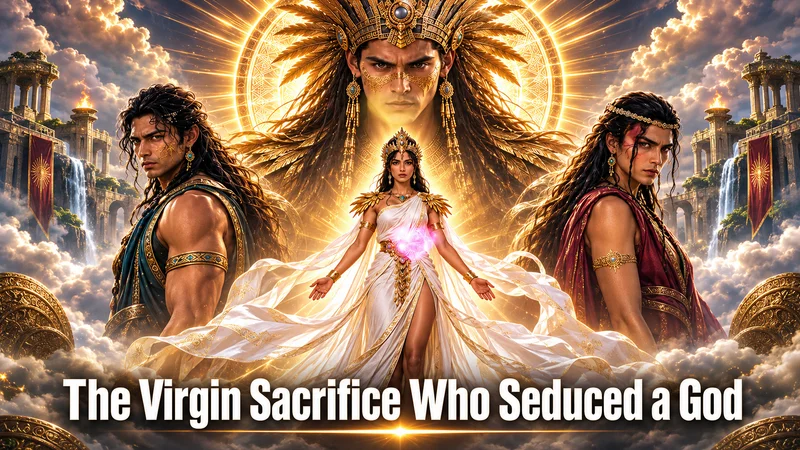
The Virgin Sacrifice Who Seduced a God review begins with an unusually cruel wedding disaster. Teyo discovers that her fiancé, Zuma, has been intimate with her sister Malin, who hopes to escape a ritual offering to Huitzil, the feared God of War. Teyo refuses to marry a man who betrayed her, only to find herself chosen as the replacement sacrifice. The surprise is that Huitzil spares her and brings her into his realm, where danger develops into a supernatural romance.
For readers following fantasy short dramas through CandyJar, the immediate attraction is the collision of sisterly betrayal, divine power, and a heroine who will not quietly accept her fiancé’s excuses. The story offers more than a new love interest with an impressive title. It asks whether a woman who has been treated as expendable can gain a meaningful choice in a world where gods and royal families decide other people’s fates.
The Virgin Sacrifice Who Seduced a God review below evaluates the verified premise, ReelShort’s character descriptions, and its public episode information. It is an editorial assessment rather than a claim to have screened all 63 installments. Spoiler note: the discussion includes Teyo’s sacrifice, Huitzil’s decision to spare her, and the former fiancé’s later regret, all described in official promotional material. It does not invent a detailed finale.
How Teyo’s Wedding Becomes a Sacrifice
Teyo is preparing to marry Zuma, the man she believes will share her future. Malin, however, is supposed to be offered to Huitzil. She seduces Zuma as part of her attempt to evade that fate, and Teyo overhears enough to discover what is happening. The confrontation exposes more than a broken engagement: Teyo’s own family is prepared to shift danger onto her while protecting the people who caused her heartbreak.
The official early episode summaries add a useful detail. After rejecting Zuma’s explanations, Teyo asks Huitzil to show mercy to Malin and Zuma, but the god instead names Teyo as the new offering. She faces a decision framed by collective punishment, with her people’s safety hanging over her response. That pressure matters because volunteering under threat is not the same as freely choosing a new life. The premise gains its emotional force from the unfairness of the demand.
Huitzil: A Frightening God With an Unexpected Attachment
Huitzil is described by ReelShort as an ancient, ruthless God of War who has accepted ritual offerings for generations without forming attachments. Teyo breaks that pattern. Instead of taking her life, he takes her to his domain, and the official synopsis describes their growing attraction. For fantasy-romance fans, that contrast between terrifying reputation and personal tenderness is an immediately recognizable draw.
The Virgin Sacrifice Who Seduced a God review becomes more complicated when we consider how the romance begins. Huitzil first demands Teyo as a sacrifice and threatens consequences if she refuses. His later mercy may transform the narrative’s direction, but it cannot erase the coercive circumstances of their first encounter. The appeal depends on how readers respond to the fantasy of an untouchable being making an exception, particularly when that being holds all the initial power.
Malin’s Betrayal Gives the Story More Than a Love Triangle
Malin is not simply a romantic competitor. Her attempt to escape the sacrificial altar sets the plot in motion, and the official description later identifies her manipulations as those of a dark sorceress. The fact that she is Teyo’s sister makes the betrayal more intimate. She exploits a danger both women should understand, then leaves Teyo exposed to it.
There is also a potentially interesting conflict beneath Malin’s cruelty. The ritual itself is frightening, and the desire to survive it is understandable. What condemns her actions is the decision to endanger someone else to secure that survival. This gives the setup a sharper question than whether one sister is prettier or more desirable: why does a system demand that either woman be sacrificed in the first place?
For comparison, Rejecting My Five Female Mates review also examines a protagonist whose longstanding bonds collapse when other people accept a manipulator’s version of events. Teyo’s story differs in its religious ritual and divine romance, but both premises turn rejection into an unexpected route toward independence. The comparison is thematic, not a claim that the two stories share a universe.
Zuma’s Regret Adds Pressure, Not an Easy Resolution

Zuma’s role begins with an unmistakable breach of trust. ReelShort’s episode descriptions show him giving in to Malin’s advances and then attempting to excuse his behavior. Later official character coverage describes his regret and the cost of his choices. His return to Teyo’s emotional orbit gives the romance a second point of tension: will she look backward toward a promised human marriage or forward toward an uncertain immortal bond?
That dilemma has dramatic value only if regret is treated as different from redemption. Feeling sorry after losing someone is not necessarily proof of change, and remorse does not oblige Teyo to return. The Virgin Sacrifice Who Seduced a God review should keep that distinction clear instead of assuming the former fiancé deserves another chance simply because the story makes him suffer.
What Works Best in the Story’s Fantasy Setup?
The concept links its major twists with unusual efficiency. A wedding betrayal explains why Teyo rejects Zuma. A threatened offering brings her before Huitzil. The god’s unexpected mercy opens a new romantic world, while Malin’s schemes and Zuma’s regret keep the human past from disappearing. Each development grows out of the central decision over who will be sacrificed.
- The heroine has an understandable emotional loss before the supernatural events begin.
- The God of War introduces romance with genuine danger and a large power imbalance.
- The sister’s wrongdoing involves survival and family loyalty, not just jealousy.
- The former fiancé’s regret creates tension without requiring Teyo to forgive him.
What Might Frustrate Some Viewers?
The premise makes heavy use of familiar short-drama devices: an unfaithful groom, a scheming sister, a powerful new love interest, and an ex who realizes his mistake too late. Viewers who already know these conventions may predict the emotional direction quickly. The story’s opportunity is to make Teyo’s choices feel specific rather than rely entirely on the pleasure of watching her betrayers lose.
Its treatment of consent deserves attention, too. The initial threat of sacrifice gives Huitzil control over Teyo before their romance develops. That can function as dark fantasy, but the relationship will not appeal equally to readers who prioritize mutual freedom from the outset. Similarly, Malin’s use of sorcery could make the rivalry more entertaining while reducing the space for ordinary human motivations.
Animation, Episode Count, and Viewing Expectations
ReelShort identifies the production as an AI-generated animated motion comic, not a live-action drama. It has 63 episodes and is listed as complete. That distinction is essential for viewers drawn in by the dramatic title: the format is stylized, and it should not be judged as if it were filmed with a conventional live-action cast. The publisher also describes the original language as English.
For The Virgin Sacrifice Who Seduced a God review, the production format is a matter of preference rather than an automatic advantage or flaw. Some viewers enjoy illustrated fantasy worlds and fast scene transitions. Others want the expressive movement and performances of live-action actors or traditional full animation. Without an independent viewing assessment, claims about the smoothness of individual sequences, voice performances, or visual consistency would be speculation.
ReelShort’s current listing states that premium episodes begin at episode 13. Availability and unlocking conditions can vary, so checking the official listing is safer than assuming the full series is freely accessible. Its 63-part structure also means that viewers should expect serialized revelations rather than the pacing of a single feature film.
Frequently Asked Questions
Is The Virgin Sacrifice Who Seduced a God worth watching?
It is worth considering for viewers who enjoy dark fantasy romance, a betrayed heroine, and a powerful immortal love interest. Those uncomfortable with forced-sacrifice premises or AI-generated motion-comic visuals may prefer something else.
Why does Huitzil spare Teyo?
ReelShort’s synopsis establishes that Teyo’s defiance captures Huitzil’s attention and that he takes her to his realm rather than killing her. The public summaries describe their developing attraction but do not independently establish every private motive behind his decision.
How many episodes are there, and is the series finished?
ReelShort lists 63 episodes and identifies the series as complete. Its official page states that premium episodes begin at episode 13.
Does Teyo get back together with Zuma?
ReelShort describes Zuma’s eventual regret and Teyo’s growing relationship with Huitzil. Those published descriptions do not support inventing a scene-by-scene final reconciliation or a definitive account of the last episode.
Final Thoughts
The Virgin Sacrifice Who Seduced a God review comes down to a troubling romantic question: can a woman betrayed by those she trusts find freedom with someone who holds greater power over her? Teyo’s defiance, Malin’s selfishness, and Huitzil’s unexpected mercy make a lively dark-fantasy premise. The romance matters most when Teyo is treated as a partner with choices, not a more cherished sacrifice.

Julian Parker is a dedicated entertainment writer at CandyJar, specializing in short dramas, captivating storylines, and trending mini-series. He shares insightful reviews, fresh perspectives, and thoughtful recommendations to help viewers discover stories worth watching.