
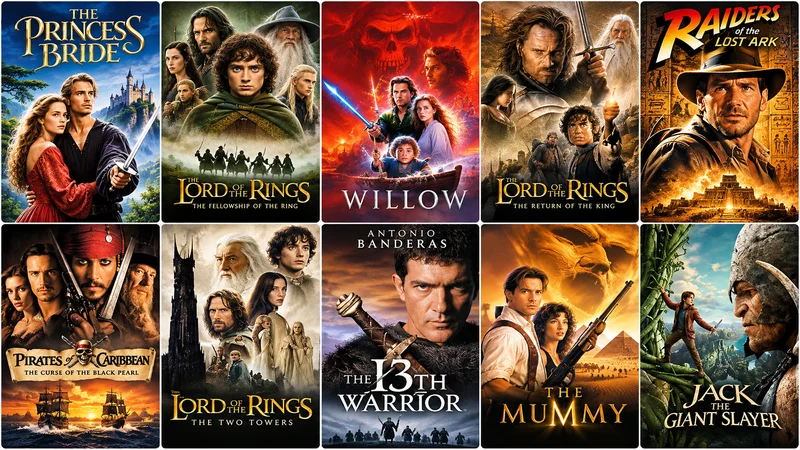
The best high fantasy movies take viewers beyond familiar reality into worlds with their own histories, magical laws, rival kingdoms and extraordinary inhabitants. Tolkien’s Middle-earth remains the genre’s best-known destination, but it is far from the only place worth exploring. This selection of 50 films includes sweeping live-action adventures, animated epics, sword-and-sorcery favorites, dragons and modern mythological spectacles.
At CandyJar, we favor stories where the invented world matters to the plot, rather than movies that briefly add a spell to otherwise ordinary life. Some films follow generations of conflict or a quest that could alter an entire civilization. Others tell more intimate stories inside richly imagined realms. Family-friendly adventures sit alongside frightening dark fantasy, with viewing notes to help you choose.
This guide to the best high fantasy movies covers releases from 1939 through 2025. The strongest matches take place in secondary worlds, while selected portal fantasies and mythological epics are identified as neighboring forms. You will find a director, a defining world feature and a viewing recommendation for each film, followed by two spoiler-conscious paragraphs explaining its story and appeal. This is an editorial viewing list, not a scientific ranking.
What Makes a Movie High Fantasy?
The best high fantasy movies are distinguished by the importance of their imagined worlds. A complete secondary world may have its own geography, peoples, history, power struggles and rules for magic. Not every story needs a world-ending battle, but the setting should influence what characters can do and why their choices matter.
- Distinct worlds: Invented kingdoms and lands possess their own cultures, conflicts and history.
- Consistent magic: Spells, enchanted objects and supernatural abilities have consequences within the story.
- Mythical inhabitants: Dragons, elves, dwarves, spirits, monsters or other beings have meaningful roles.
- Large stakes: Quests and wars often affect more than one person or family.
- Heroic journeys: Ordinary figures may become leaders, guardians or reluctant bearers of dangerous powers.
- Political and moral conflict: Alliances, dynasties, rival cultures and tempting powers complicate simple notions of good and evil.
- Recognizable boundaries: Portal fantasy enters an invented world from ours, while mythic fantasy reworks real folklore; both overlap with high fantasy but are not always identical.
Start with The Fellowship of the Ring for foundational world-building or Dungeons & Dragons: Honor Among Thieves for an accessible ensemble quest. The Dark Crystal and Mune: Guardian of the Moon offer unusually original worlds, while The Spine of Night and The Witcher films are intended for mature viewers. If you prefer dragon-centered adventures, the How to Train Your Dragon films provide a lighter path.
The Great Fantasy Sagas: Middle-earth and Narnia
The best high fantasy movies often begin with worlds whose geography and history feel larger than any single character. Middle-earth and Narnia show how different cultures, past conflicts and forms of magic can support multi-film journeys. These ten selections belong to interconnected sagas, so watch each series in story order.
1. The Lord of the Rings: The Fellowship of the Ring (2001)
- Director: Peter Jackson
- Fantasy elements: Middle-earth, the One Ring, elves and wizards
- Best for: First-time viewers and immersive world-building
Frodo Baggins inherits a ring tied to the return of Sauron, a dark power threatening Middle-earth. Leaving the Shire, he joins an unlikely fellowship whose members must carry a dangerous object toward the land where it can be destroyed. Forests, ancient kingdoms and unfamiliar peoples make the journey feel larger with every step.
The film makes its invented world believable through geography, history and differences between its cultures. Its greatest achievement is giving an enormous conflict a relatable beginning: one frightened hobbit choosing responsibility. Start here before watching either sequel.
2. The Lord of the Rings: The Two Towers (2002)
- Director: Peter Jackson
- Fantasy elements: Rohan, Isengard, Ents and the growing shadow of Mordor
- Best for: Parallel quests and large-scale warfare
The Fellowship has broken apart. Frodo and Sam approach Mordor with the unpredictable Gollum, while Aragorn and his companions become involved in the defense of Rohan. The rise of Saruman and his army places a divided kingdom under terrible pressure, forcing its people to choose between retreat and resistance.
The Battle of Helm’s Deep remains a defining example of fantasy warfare, but the quieter journeys are just as important. The film shows how alliances between peoples with conflicting interests can shape the future of a world. Watch it between the first and third installments.
3. The Lord of the Rings: The Return of the King (2003)
- Director: Peter Jackson
- Fantasy elements: Gondor, Mordor, legendary armies and an ancient evil
- Best for: Emotional payoffs and epic conclusions
As Sauron prepares to overwhelm Gondor, Aragorn must face the responsibilities attached to his lineage. Elsewhere, Frodo and Sam continue a mission on which the larger war depends, struggling against exhaustion and the corrupting influence of the Ring. Several journeys converge as the fate of Middle-earth hangs in the balance.
This is the reward for investing in Tolkien’s complex world: battles matter because the characters and cultures matter. Peter Jackson delivers spectacle while retaining a moving focus on loyalty, sacrifice and the dangers of power. It is not a standalone starting point.
4. The Hobbit: An Unexpected Journey (2012)
- Director: Peter Jackson
- Fantasy elements: Dwarven history, goblins, wizards and a dragon-haunted mountain
- Best for: A lighter Middle-earth quest
Bilbo Baggins is persuaded to accompany Thorin Oakenshield and a band of dwarves seeking to reclaim their ancestral home. The seemingly timid hobbit encounters trolls, goblins and difficult roads as the travelers move farther from the safety of the Shire. Their goal is shadowed by the dragon occupying the Lonely Mountain.
Martin Freeman gives Bilbo an appealing mixture of irritation and emerging courage. The story offers a more playful introduction to Tolkien’s creatures than the main trilogy, although the adaptation expands the original book considerably. It is best viewed as the first chapter of a three-film journey.
5. The Hobbit: The Desolation of Smaug (2013)
- Director: Peter Jackson
- Fantasy elements: Mirkwood, the Woodland Realm and the dragon Smaug
- Best for: Dragon encounters and adventurous peril
Thorin’s company continues toward the Lonely Mountain, passing through a dangerous forest and territories governed by peoples with their own concerns. Bilbo becomes increasingly important to the mission as the dwarves approach the treasure-filled halls they hope to reclaim. Smaug is far more than a creature guarding a cave.
The conversation between Bilbo and Smaug is particularly effective because words become a contest between intelligence and predatory power. The film expands the variety of Middle-earth settings while allowing its dragon a vivid personality. Begin with An Unexpected Journey to understand the dwarves’ purpose.
6. The Hobbit: The Battle of the Five Armies (2014)
- Director: Peter Jackson
- Fantasy elements: Competing kingdoms, dwarven treasure and a gathering war
- Best for: Fantasy battles and political loyalties
After the confrontation at the Lonely Mountain, the treasure inside becomes a source of conflict among dwarves, elves and humans. Thorin’s decisions threaten relationships that sustained the expedition, while more dangerous forces draw near. Bilbo finds himself attempting to prevent a struggle that seems increasingly difficult to stop.
The final Hobbit film places questions of greed and leadership beside a massive fantasy battle. It is more focused on warfare than discovery, yet its central conflict rests on the choices of characters introduced across the trilogy. Watch the earlier films first.
7. The Lord of the Rings: The War of the Rohirrim (2024)
- Director: Kenji Kamiyama
- Fantasy elements: Rohan, the Hornburg and Middle-earth royal history
- Best for: Animated warfare and an independent Tolkien-era story
Set long before Frodo’s journey, this animated feature follows King Helm Hammerhand and his daughter Héra as a violent dispute threatens Rohan. The kingdom must organize a defense against an enemy driven by revenge, with the ancient fortress later known as Helm’s Deep becoming central to its survival.
The film extends Middle-earth beyond its familiar heroes while using Japanese-style animation to portray the culture of Rohan. Its conflicts involve political decisions and family loyalty more than extensive spellcasting, making it a grounded branch of a fully imagined fantasy world.
8. The Chronicles of Narnia: The Lion, the Witch and the Wardrobe (2005)
- Director: Andrew Adamson
- Fantasy elements: Narnia, talking animals, Aslan and the White Witch
- Best for: Family-friendly portal fantasy with large stakes
Four children evacuated from wartime Britain discover a wardrobe that opens into Narnia, a realm trapped in supernatural winter. Its inhabitants are divided between the authority of the White Witch and hope connected to the lion Aslan. The siblings are drawn into an ancient prophecy they barely understand.
Although the human characters enter from our world, nearly all the adventure unfolds within a kingdom with its own creatures, history and magical rules. That makes Narnia an important high fantasy crossover. It is an approachable starting point for families, with some frightening battle imagery.
9. The Chronicles of Narnia: Prince Caspian (2008)
- Director: Andrew Adamson
- Fantasy elements: Ancient Narnian peoples and a threatened throne
- Best for: Royal rebellion and woodland magic
The Pevensie siblings return to Narnia to discover that generations have passed and the old magical inhabitants have been driven into hiding. Prince Caspian hopes to challenge the ruler threatening his claim, but rebuilding an alliance across cultures proves difficult. The children must learn that the kingdom has changed since their previous visit.
The larger battles give this sequel a more martial tone, while its emotional focus lies in questions of belonging and leadership. The forests and ruins suggest an invented world with a past that continues shaping the present. Watch the first Narnia film beforehand.
10. The Chronicles of Narnia: The Voyage of the Dawn Treader (2010)
- Director: Michael Apted
- Fantasy elements: Enchanted islands, a dragon and the seas of Narnia
- Best for: Seafaring quests and episodic magical encounters
Lucy, Edmund and their cousin Eustace are drawn into Narnia and join King Caspian on a voyage to find missing noblemen. Each island introduces new mysteries, strange inhabitants or magical temptations. The journey moves farther from familiar lands, making the sea itself an invitation to discover the limits of the kingdom.
This adventure trades castle battles for exploration and character growth. Eustace’s encounter with magic gives the film an especially recognizable emotional arc. It is a gentler choice for viewers who enjoy unusual creatures, enchanted places and quests structured around several destinations.
Invented Kingdoms, Magical Quests and Beloved Adventures
Not all the best high fantasy movies require several sequels. A self-contained kingdom, a memorable magical rule or an unusual traveling party can make a world feel complete. These films range from funny and romantic journeys to dark puppetry and dangerous dragons, with portal fantasy included where the invented realm dominates the adventure.
11. Dungeons & Dragons: Honor Among Thieves (2023)
- Director: Jonathan Goldstein and John Francis Daley
- Fantasy elements: Forgotten Realms, sorcerers, enchanted relics and monsters
- Best for: Funny ensemble quests and accessible modern fantasy
Edgin and his companions set out to recover a powerful relic while attempting to repair the damage caused by an earlier job. Their plans depend on a druid, a sorcerer and other allies whose abilities work very differently. The quest grows increasingly dangerous as the group discovers that rival forces have plans of their own.
This is one of the easiest fantasy worlds to enter without prior knowledge of its tabletop inspiration. Distinct character abilities, magical cities and strange creatures make the setting feel playable, yet friendship and accountability remain the focus. The film balances humor and action effectively.
12. Warcraft (2016)
- Director: Duncan Jones
- Fantasy elements: Azeroth, orc clans, humans and magical portals
- Best for: Factions, spellcasters and massive fantasy battles
As their homeworld deteriorates, orc clans enter Azeroth through a portal and clash with human kingdoms that fear invasion. Leaders and families on both sides face difficult choices about loyalty and survival, while powerful magic complicates the conflict. The story gives the opposing civilizations motives beyond a simple struggle between heroes and monsters.
The film draws deeply from video-game lore, so newcomers may need to absorb many names and alliances. Its strongest appeal is the scale of its secondary world and the visual contrast between cultures. Choose it for armies, creatures and magic rather than intimate detective-style plotting.
13. Willow (1988)
- Director: Ron Howard
- Fantasy elements: A magical kingdom, sorceresses and a threatened child
- Best for: Classic heroic adventure and unlikely companions
Willow Ufgood, a farmer who hopes to learn magic, is entrusted with an infant whose survival threatens the rule of Queen Bavmorda. He leaves his small community and joins an unpredictable group of allies, including the warrior Madmartigan. Their travels lead through dangerous landscapes and encounters with powerful supernatural forces.
Warwick Davis makes Willow relatable because the hero never begins as a confident champion. Ron Howard combines humor, creatures and a clear mission in a world that feels larger than its characters. It is a valuable 1980s fantasy selection for audiences who love underdog adventures.
14. The Dark Crystal (1982)
- Director: Jim Henson and Frank Oz
- Fantasy elements: Thra, the Skeksis and an ancient damaged crystal
- Best for: Immersive puppet fantasy and strange civilizations
Jen, a young Gelfling, is asked to repair a damaged crystal whose broken state has upset the balance of his world. His journey brings him into contact with unfamiliar beings and the ruthless Skeksis, whose power depends on preserving the existing order. The history of Thra is gradually revealed through places and inhabitants.
Elaborate puppetry makes this fantasy realm feel physically distinct from a live-action set. Its cultures and creatures are not variations of modern human society, giving the film an unusually complete secondary-world identity. The frightening imagery may be too intense for some young children.
15. The NeverEnding Story (1984)
- Director: Wolfgang Petersen
- Fantasy elements: Fantasia, a mysterious force called the Nothing and fantastical beings
- Best for: Imagination-driven portal fantasy
Bastian discovers a book about Fantasia, a realm threatened by a destructive force known as the Nothing. As he follows Atreyu’s mission to save the world, he begins to realize that the story may involve him more directly than an ordinary book should. Creatures and landscapes represent the extraordinary reach of imagination.
Its real-world framing makes this a portal fantasy rather than a pure secondary-world film, but Fantasia itself is richly invented. The movie blends wonder with sadness, especially when characters struggle to preserve a world being erased. It is a defining family fantasy of the 1980s.
16. The Princess Bride (1987)
- Director: Rob Reiner
- Fantasy elements: A fairy-tale kingdom, swordfighters and improbable creatures
- Best for: Romance and adventure with clever humor
Buttercup and Westley are separated by circumstances that appear to end their hopes of being together. Royal ambitions, kidnappers and dangerous adversaries turn their story into a quest filled with duels and surprising alliances. The framing device presents the adventure as a tale read to a child.
This is a lighter edge of high fantasy: a fictional kingdom and larger-than-life challenges without an elaborate magic system. Its emotional appeal lies in loyalty, wit and an unwillingness to give up. It is especially enjoyable when viewers want romance alongside heroic adventure.
17. Stardust (2007)
- Director: Matthew Vaughn
- Fantasy elements: Stormhold, fallen stars, witches and magical royal succession
- Best for: Romantic quest fantasy and whimsical world-building
Tristan crosses a wall from his ordinary village into the magical kingdom of Stormhold to retrieve a fallen star. Discovering that the star is a woman named Yvaine transforms the mission, especially as witches and royal rivals pursue her. The two travelers must navigate a landscape where seemingly minor encounters conceal magical dangers.
The film combines a strongly imagined fantasy realm with romance that develops through shared adventure. Its fairy-tale logic is clear enough for newcomers yet populated with lively secondary characters. Choose it when you want a high fantasy setting that does not feel relentlessly grim.
18. Dragonheart (1996)
- Director: Rob Cohen
- Fantasy elements: A dragon bound by magic to a troubled kingdom
- Best for: Knightly adventure and a sympathetic mythical creature
Bowen, a knight disappointed by the ruler he once trained, encounters Draco, a dragon whose fate is linked to the kingdom’s corruption. Their unusual alliance forces Bowen to reconsider what he believes about dragons and honor. The struggle to challenge the throne becomes personal as the magical connection is understood.
Sean Connery gives Draco humor and emotional presence, making him much more than an impressive visual effect. Dragonheart belongs to medieval-inspired fantasy rather than a complex mapped secondary world, but its dragons, curses and royal conflict make it a useful neighboring choice.
19. Damsel (2024)
- Director: Juan Carlos Fresnadillo
- Fantasy elements: A fictional royal realm, ancestral bargains and a dragon
- Best for: Fantasy survival with a self-reliant heroine
Elodie agrees to a royal marriage that promises security for her family, only to discover a concealed tradition demanding a terrible sacrifice. Trapped in a dangerous cavern, she must confront a dragon and find her own route to safety. Knowledge of the kingdom’s past proves as important as physical endurance.
Millie Bobby Brown makes Elodie’s problem-solving central to a fairy tale that rejects passive rescue. The film is narrower in scale than an epic war, but its invented royal customs and ancient creature give the world a clear mythic identity. Choose it for immediate peril rather than extensive lore.
20. The Wizard of Oz (1939)
- Director: Victor Fleming
- Fantasy elements: Oz, witches, the Emerald City and enchanted companions
- Best for: Foundational portal fantasy and musical wonder
Dorothy is carried from Kansas into the Land of Oz and joins three unusual companions on a journey to the Emerald City. Their route passes through territories controlled by witches and other powerful figures. Each traveler believes the mysterious Wizard can provide something essential to a happier future.
Oz is one of cinema’s most recognizable invented worlds, even though the story begins and ends in everyday reality. Its geography, magical rules and distinctive communities make it essential to the history of screen fantasy. This is an especially welcoming choice for families and classic-film viewers.
Sword-and-Sorcery Classics and Dark Fantasy Worlds
A different side of the best high fantasy movies favors strange sorcerers, cursed kingdoms and heroes who cannot rely on a comfortable moral order. Some of these selections are close relatives of medieval fantasy rather than strict secondary-world epics, and the notes make that distinction clear. Expect older practical effects, intense creatures and occasional adult violence.
21. Legend (1985)
- Director: Ridley Scott
- Fantasy elements: A fairy-tale realm, unicorns and the Lord of Darkness
- Best for: Dreamlike design and dark fairy-tale atmosphere
Jack becomes involved in a struggle to protect a magical world after a threat to its unicorns endangers the balance between light and darkness. The Lord of Darkness attempts to use the crisis to gain power and claim a young princess. The journey leads through an enchanted forest filled with otherworldly creatures.
Ridley Scott’s detailed sets and practical effects create a dreamlike visual world. Tim Curry makes the antagonist particularly memorable, while the story itself follows simple fairy-tale stakes. Different released versions feature different musical scores, making the film an interesting example of fantasy shaped by sound and imagery.
22. Krull (1983)
- Director: Peter Yates
- Fantasy elements: A threatened fantasy planet, the Glaive and the Beast
- Best for: Sword-and-sorcery with science-fantasy elements
Prince Colwyn sets out to rescue Princess Lyssa after a powerful invader disrupts their planned marriage and threatens their kingdom. To challenge the enemy, he searches for a legendary weapon and gathers allies across an unusual landscape. The adventure mixes medieval-style warriors with an almost extraterrestrial menace.
The genre blending makes Krull distinctive among 1980s fantasy productions. Its characters and mythical weapons follow quest-story traditions, while the enemy’s fortress suggests science fiction. The result is a cult adventure best appreciated for visual invention and an adventurous musical score.
23. Conan the Barbarian (1982)
- Director: John Milius
- Fantasy elements: The Hyborian Age, sorcery and warring peoples
- Best for: Mature sword-and-sorcery adventure
Conan survives the destruction of his community and grows into a formidable fighter whose journey leads toward the cult responsible for his suffering. He travels through an imagined ancient world populated by mercenaries, thieves and practitioners of dark magic. Revenge provides the initial purpose, but the conflict expands toward questions of strength and identity.
Arnold Schwarzenegger’s physical performance and Basil Poledouris’s score give the film a mythic force. The Hyborian Age is an invented setting inspired by many historical cultures, not a recreation of any one real era. It contains graphic violence and adult material.
24. Dragonslayer (1981)
- Director: Matthew Robbins
- Fantasy elements: A dragon, a wizard’s apprentice and a fearful kingdom
- Best for: Dark medieval-style creature fantasy
A kingdom attempts to appease the dragon Vermithrax by offering young women through a lottery. When an aging sorcerer is asked to end the terror, his apprentice Galen must confront a task far beyond his experience. The danger reveals how political authority can hide behind fearful tradition.
Its practical dragon effects give the creature extraordinary presence. The story is smaller than a continent-spanning epic but grounded in a coherent kingdom with dangerous magical beliefs. Choose it for an older, darker vision of dragons rather than a friendly creature adventure.
25. The Beastmaster (1982)
- Director: Don Coscarelli
- Fantasy elements: A fictional ancient realm, animal communication and a tyrant
- Best for: Sword-and-sorcery and animal companions
Dar is a young warrior whose unusual bond with animals helps him survive after his family and community are threatened. As he grows into his abilities, he sets out against a powerful ruler and the forces supporting him. His animal companions become essential allies across the hostile fantasy landscape.
The Beastmaster is a pulpy and sometimes eccentric example of the early-1980s fantasy boom. It emphasizes a hero’s special gift and a clear struggle against tyranny rather than intricate political history. Viewers seeking adventure with an unmistakably retro character will find its unusual animal partnership memorable.
26. The Sword and the Sorcerer (1982)
- Director: Albert Pyun
- Fantasy elements: A fictional kingdom, a monstrous sorcerer and a mercenary prince
- Best for: Cult fantasy action with mature themes
Prince Talon becomes involved in a violent attempt to challenge a usurper whose rise to power involved the awakening of an evil sorcerer. Armed with an unusual three-bladed sword, he moves between political rivals, mercenaries and forces connected to dangerous magic. The kingdom’s future depends on confrontations driven by personal debts and ambition.
This is a rough-edged sword-and-sorcery film rather than a polished modern epic. Its practical creature effects and exaggerated action capture a particular era of fantasy filmmaking. The violence and adult tone make it more suitable for viewers exploring cult genre history.
27. The Last Unicorn (1982)
- Director: Arthur Rankin Jr. and Jules Bass
- Fantasy elements: A hidden unicorn, sorcery and the Red Bull
- Best for: Poetic animated fantasy and melancholy
A unicorn becomes convinced that she may be the last of her kind and leaves her forest to discover what happened to the others. Her journey brings her into contact with the inexperienced magician Schmendrick and companions whose lives are shaped by longing and transformation. A remote kingdom holds clues about the missing unicorns.
The film’s beauty lies in its reflective tone and memorable creatures, not in constant combat. Its fairy-tale setting makes it a close relative of high fantasy, with a quest and powerful supernatural rules. For readers who especially enjoy castles and enchanted legends, our list of best medieval fantasy movies provides a complementary selection.
28. The Flight of Dragons (1982)
- Director: Arthur Rankin Jr. and Jules Bass
- Fantasy elements: Rival wizards, dragons and a threatened magical realm
- Best for: Animated quest fantasy with inventive rules
The wizard Carolinus fears that magic will disappear as human civilization becomes more devoted to logic. He organizes a quest to protect the magical realm from a malevolent rival, drawing an unlikely modern thinker into the adventure. Dragons, unusual companions and competing philosophies shape the journey.
This animated film stands out by treating magic and science as concepts that can challenge each other. Its mythology is more elaborate than its modest visual scale might suggest. Choose it if you enjoy fantasy stories that invent specific explanations for magical creatures and their relationship to the wider world.
29. The Black Cauldron (1985)
- Director: Ted Berman and Richard Rich
- Fantasy elements: Prydain, an enchanted cauldron and the Horned King
- Best for: Dark Disney animation and an inexperienced hero
Taran, an assistant pig keeper, becomes involved in the struggle to prevent the Horned King from obtaining a cauldron capable of raising an unstoppable army. His journey introduces an unusual group of allies and hazards that force him to reconsider his assumptions about heroism. The kingdom’s future becomes connected to a seemingly ordinary boy.
Based on Lloyd Alexander’s fantasy material, the film condenses a complex literary world into a darker animated adventure. It features frightening imagery and a memorable villain. Its clear secondary-world setting makes it especially relevant for younger viewers ready for more ominous fantasy.
30. Return to Oz (1985)
- Director: Walter Murch
- Fantasy elements: Oz, the Nome King and the ruined Emerald City
- Best for: Dark portal fantasy and strange creatures
Dorothy returns to Oz and finds that the kingdom she once knew has become a devastated place. Familiar friends are missing or transformed, while dangerous new rulers control important regions. With the help of unusual companions such as Tik-Tok and Jack Pumpkinhead, she attempts to restore the world.
This is a much darker vision of Oz than the famous 1939 musical, with elaborate practical creatures and disturbing imagery. Like its predecessor, it begins in our world but spends its fantasy adventure inside a distinctive invented realm. Children sensitive to frightening characters may prefer the earlier film.
Animated High Fantasy and Dragon-Filled Worlds
Animation is especially effective at creating worlds that could not exist without magic. Among the best high fantasy movies, these ten entries build complete realms through hand-drawn artwork, computer animation and unusual creature designs. Several are family adventures, while the newer live-action dragon film is clearly identified as a remake.
31. The Hobbit (1977)
- Director: Arthur Rankin Jr. and Jules Bass
- Fantasy elements: Animated Middle-earth and Bilbo’s dragon-haunted quest
- Best for: Classic animated Tolkien adaptation
Bilbo Baggins is drawn from his peaceful home into an expedition led by dwarves seeking to recover treasure from the dragon Smaug. The journey introduces trolls, goblins, elves and magical obstacles while asking Bilbo to discover courage he did not know he possessed.
This animated interpretation tells the core adventure more compactly than Peter Jackson’s trilogy. Its visual style and songs have an old-fashioned charm, giving Tolkien’s world a storybook quality. It is a useful way for families and fantasy-history enthusiasts to explore an earlier screen version.
32. The Lord of the Rings (1978)
- Director: Ralph Bakshi
- Fantasy elements: Animated Middle-earth and the growing threat of Sauron
- Best for: Experimental animation and Tolkien adaptation history
Frodo receives the One Ring and leaves the Shire with companions who hope to prevent Sauron from reclaiming it. Their journey leads through threatened kingdoms and ancient lands, while the conflict grows beyond the fate of any one traveler. The film covers only part of Tolkien’s larger story.
Ralph Bakshi combines traditional animation with rotoscoped live-action movement, giving battles and crowds an unusual visual texture. Its incomplete adaptation should not be mistaken for the full novel trilogy. It remains a fascinating alternative vision of Middle-earth for fans interested in fantasy cinema history.
33. Tales from Earthsea (2006)
- Director: Goro Miyazaki
- Fantasy elements: Earthsea, archmages, dragons and disturbed magic
- Best for: Animated literary-world fantasy
Prince Arren travels with the mage Sparrowhawk through Earthsea, a world where the balance between life and death is becoming unstable. Their path intersects with a young woman named Therru and an enemy pursuing forbidden power. Dragons and ancient magical principles loom over the journey.
The film draws from Ursula K. Le Guin’s Earthsea universe while making substantial changes to its books. The archipelago and its magic system place it among the clearest secondary-world choices on this list. Its atmosphere is intriguing even though viewers familiar with the novels may have reservations about the adaptation.
34. Mune: Guardian of the Moon (2014)
- Director: Benoît Philippon and Alexandre Heboyan
- Fantasy elements: A mythic world governed by guardians of the sun and moon
- Best for: Imaginative French animation and a young guardian
Mune is unexpectedly chosen to protect the moon in a world where celestial guardians control the cycle of light and darkness. His early mistakes lead to a crisis when the sun is stolen. Joined by a warrior guardian and a girl made of wax, he sets out to restore the balance of their world.
The unusual cosmology gives this animated film a strong high fantasy identity despite its family-friendly scale. Its designs combine softness and grandeur, while the young hero’s uncertainty keeps the story approachable. The film premiered in 2014 and received wider releases in later years.
35. Raya and the Last Dragon (2021)
- Director: Don Hall and Carlos López Estrada
- Fantasy elements: Kumandra, ancient dragons and fractured lands
- Best for: Animated world-building and a quest for trust
Raya seeks the last dragon after a magical catastrophe divides the people of Kumandra and threatens the world. Her journey moves through several lands with distinct traditions and conflicting attitudes toward cooperation. Recovering a lost power becomes closely connected to rebuilding trust among communities that have hurt one another.
Kumandra feels like a secondary world with its own history and regional identities. The film draws visual and cultural inspirations from Southeast Asia without depicting any one real nation. Its message about trust is direct, making it an accessible fantasy adventure for families.
36. How to Train Your Dragon (2010)
- Director: Chris Sanders and Dean DeBlois
- Fantasy elements: Berk, dragon species and a mythic Viking-inspired society
- Best for: Friendship, flying creatures and accessible fantasy
Hiccup is the son of a village chief in a community taught to fear and fight dragons. His encounter with an injured Night Fury challenges everything he has learned. As he secretly develops a bond with the creature he names Toothless, the relationship threatens his standing among his people and opens a different future for the island.
The film builds an imaginative world around the biology and behavior of its dragons. Although its Vikings are historically inspired, Berk is an invented fantasy setting. Its emotional strength comes from showing understanding overcome inherited fear, making it ideal for newcomers to creature-centered adventures.
37. How to Train Your Dragon 2 (2014)
- Director: Dean DeBlois
- Fantasy elements: New dragon habitats, rival forces and the wider Viking world
- Best for: Expanded lore and emotional sequel storytelling
Years after Hiccup and Toothless changed their community’s relationship with dragons, they explore distant lands and encounter new threats. The discovery of a hidden dragon sanctuary reveals that their world is larger and more complex than they knew. Hiccup must consider what leadership will demand from him.
The sequel expands the rules of its fantasy setting while developing family relationships and the consequences of conflict. Its flight sequences are visually exhilarating, but the emotional changes have lasting importance. Watch the first film before this chapter.
38. How to Train Your Dragon: The Hidden World (2019)
- Director: Dean DeBlois
- Fantasy elements: A secret dragon homeland and the future of Berk
- Best for: A concluding journey about friendship and change
Hiccup and Toothless face a threat that places Berk’s dragons in danger. The discovery of a mysterious dragon and rumors of an unknown refuge create difficult choices about safety and belonging. Hiccup must determine whether protecting the creatures he loves means holding on to them or allowing them to leave.
The film is a visually beautiful conclusion to the animated trilogy, giving its imaginative creatures an emotionally meaningful future. Its central conflict concerns stewardship rather than simply defeating an enemy. The first two films provide essential context.
39. How to Train Your Dragon (2025)
- Director: Dean DeBlois
- Fantasy elements: A live-action return to Berk and its dragons
- Best for: Live-action reimagining of an animated favorite
This live-action version returns to Hiccup, the young Viking who befriends the dragon Toothless against his community’s expectations. His discovery challenges Berk’s long-standing traditions and creates the possibility of a different relationship between humans and dragons. Familiar characters and conflicts are presented with real actors and digital creatures.
Dean DeBlois revisits the material he helped bring to the screen in 2010. It is a reimagining, not a sequel to the animated trilogy, and should be listed separately to avoid confusing the two releases. Choose it if you prefer live-action fantasy spectacle.
40. Spellbound (2024)
- Director: Vicky Jenson
- Fantasy elements: Lumbria, transformation magic and a royal family
- Best for: Musical family fantasy with a quest
Princess Ellian lives in the kingdom of Lumbria, where a spell has transformed her parents into monsters. Hoping to restore their family and save the kingdom, she begins a journey involving magical beings and obstacles. Her urgent quest reveals that the spell is connected to problems within the household.
The animated musical features a fully invented realm with supernatural laws, even though its emotional concerns are domestic. Rachel Zegler voices Ellian, and Alan Menken provides music. It is better for viewers seeking bright family fantasy than for those wanting grim battles.
Witchers, Global Mythology and New Epic Fantasy
The best high fantasy movies also draw on storytelling traditions beyond Tolkien. This final group includes an invented world of monster hunters, adult animation and spectacular interpretations of Chinese myth, plus a Japanese game-inspired quest. The mythological selections adapt existing legends rather than claiming to invent every part of their settings.
41. The Witcher: Nightmare of the Wolf (2021)
- Director: Kwang Il Han
- Fantasy elements: The Continent, witchers and persecuted monsters
- Best for: Adult animated dark fantasy and monster lore
Vesemir escapes poverty and becomes a witcher, a professional monster hunter whose abilities come at a cost. His work earns wealth and recognition, but a growing supernatural danger forces him to reckon with his past and the institutions that trained him. The conflict reveals deeper tensions between humans, mages and mutated warriors.
This Netflix animated feature explores the world that eventually shapes Geralt of Rivia. Its violent action and mature themes make it unsuitable for younger audiences. The film is particularly rewarding for viewers curious about witcher history and a fantasy society built around fear of monsters.
42. The Witcher: Sirens of the Deep (2025)
- Director: Kang Hei Chul
- Fantasy elements: The Continent, merpeople and rival coastal kingdoms
- Best for: Animated monster mystery and political fantasy
Geralt of Rivia investigates attacks near a coastal village and is pulled into a long-standing conflict between humans and merpeople. The mission becomes more complicated as each side offers a different account of what has happened. Geralt must consider how to prevent a local mystery from turning into a larger war.
Based on a Witcher story, this animated film uses an established secondary world where supernatural species have political interests of their own. It is a dark, adult-oriented alternative to lighter dragon adventures. Its 2025 release is confirmed by Netflix.
43. The Spine of Night (2021)
- Director: Philip Gelatt and Morgan Galen King
- Fantasy elements: A violent fantasy world transformed by ancient magic
- Best for: Rotoscoped epic fantasy horror for adults
An ancient magical power passes through the hands of people with very different ambitions, bringing suffering to societies across several eras. Warriors, scholars and other figures become caught in struggles that reshape the world around them. The narrative spans multiple generations rather than following one conventional heroic quest.
This animated feature uses rotoscoping to evoke older fantasy cinema while embracing brutal violence and horror imagery. Its self-contained setting and long historical scale are unmistakably high fantasy. It is appropriate only for mature viewers comfortable with extreme violence.
44. Ne Zha (2019)
- Director: Jiaozi
- Fantasy elements: Chinese mythological realms, divine powers and an unusual child hero
- Best for: Energetic animated mythology and destiny
Ne Zha is born under a troubling prophecy and grows up treated as a danger by the people around him. His extraordinary powers and difficult reputation create tension with his family and community. As a larger supernatural conflict develops, he must decide whether the identity assigned to him will determine his choices.
The film adapts characters from Chinese mythology into a colorful modern animated fantasy. Its gods, dragons and cosmic rules create a mythic realm with large stakes, though its traditions are rooted in existing folklore rather than wholly invented. It is a good starting point before the sequel.
45. Ne Zha 2 (2025)
- Director: Jiaozi
- Fantasy elements: Divine trials, dragon clans and magical realms
- Best for: Spectacular mythology with emotional stakes
Following the events of the first film, Ne Zha and Ao Bing face new threats that involve supernatural powers and the future of their communities. Their relationship and family loyalties are tested as the conflict expands across divine and mortal interests. Previous decisions matter greatly to the new struggle.
Jiaozi expands the animated mythology with elaborate action and larger magical environments. It is a direct sequel, so watch Ne Zha first. The 2025 release provides a recent example of high-stakes fantasy grounded in Chinese mythological traditions.
46. Creation of the Gods I: Kingdom of Storms (2023)
- Director: Wuershan
- Fantasy elements: Ancient Chinese mythology, immortals and competing kingdoms
- Best for: Live-action mythic epic and royal intrigue
King Yin Shou’s growing power threatens the balance of the realm as supernatural forces influence rival leaders and families. A conflict over the fate of the Shang dynasty draws Jiang Ziya and other figures into a struggle involving divine artifacts and political legitimacy. Personal loyalties become inseparable from the actions of gods and immortals.
Inspired by the classic Investiture of the Gods, the film blends historical Chinese imagery with explicitly fantastic mythology. It is a mythic epic rather than a historically factual retelling. Its large cast and supernatural politics reward careful attention.
47. Creation of the Gods II: Demon Force (2025)
- Director: Wuershan
- Fantasy elements: Xiqi, Shang armies and immortals from Kunlun
- Best for: Large-scale mythological battles and magical armies
Ji Fa and Jiang Ziya face a major attack on Xiqi as the forces of the Shang dynasty attempt to impose their rule. Their defense depends on alliances with immortals and fighters whose magical abilities can change the course of battle. The struggle over the Fengshen Bang remains central to the conflict.
The sequel expands the visual scale of the first film, introducing supernatural armies and larger confrontations. Because it continues the same mythology and political relationships, the original installment should be watched first. Its 2025 release and central premise are documented by its distributor.
48. The Monkey King (2014)
- Director: Soi Cheang
- Fantasy elements: Heavenly courts, demon realms and Sun Wukong
- Best for: Chinese mythological action and celestial spectacle
Sun Wukong, the Monkey King, grows into a formidable supernatural figure whose extraordinary abilities disrupt the established order of Heaven. His conflicts with powerful beings take him across realms governed by their own rules. The story draws on the early legend surrounding a hero celebrated for both rebellion and strength.
The film uses extravagant visual effects and martial-arts action to present mythological environments at blockbuster scale. The story is adapted from Chinese literary tradition rather than a wholly original secondary world, so it belongs to the mythic branch of high fantasy. Viewers should expect spectacle over subtle character study.
49. White Snake (2019)
- Director: Amp Wong and Ji Zhao
- Fantasy elements: Serpent spirits, sorcery and a folkloric ancient China
- Best for: Animated mythic romance and magical adventure
A young woman with lost memories is rescued by a snake catcher named Xuan. As they search for clues to her identity, powerful enemies and supernatural forces complicate their journey. Their developing feelings become inseparable from the mystery of what she really is and the rules governing spirit beings.
This Chinese animated film draws from the Legend of the White Snake, making it a folklore-based fantasy rather than a completely invented world. Its magical confrontations and distinctive creature society still offer the scale and wonder high fantasy fans seek. Romance is central, but the adventure has substantial supernatural stakes.
50. Dragon Quest: Your Story (2019)
- Director: Takashi Yamazaki, Ryuichi Yagi and Makoto Hanafusa
- Fantasy elements: A game-inspired kingdom, monsters, magic and a heroic lineage
- Best for: Japanese animated fantasy adventure
Luca grows from childhood into an adventurer whose life becomes connected to an enduring struggle against evil. He travels through a world populated by monsters, allies and magical challenges, while family relationships shape the decisions facing him. The film adapts the broad story of the role-playing game Dragon Quest V.
Its castles, spells and creature-filled lands strongly resemble a playable high fantasy world. Computer animation gives the adventure a lively sense of scale, although fans of the game may have strong opinions about the adaptation. It is an accessible introduction to Japanese role-playing fantasy on screen.
Frequently Asked Questions
What are the best high fantasy movies for beginners?
The best high fantasy movies for newcomers include The Lord of the Rings: The Fellowship of the Ring, Willow, Dungeons & Dragons: Honor Among Thieves and Raya and the Last Dragon. For younger viewers, the first How to Train Your Dragon is an inviting starting point. The Dark Crystal may appeal to older children comfortable with ominous creatures.
What is the difference between high fantasy and low fantasy?
High fantasy generally takes place in a secondary world with its own history and magical rules. Low fantasy typically brings supernatural elements into a more familiar world, although definitions vary among critics. Narnia and Oz are portal fantasies: their protagonists begin in our world but spend much of the adventure in a separate magical realm.
Are all medieval fantasy movies high fantasy?
No. A film may contain castles, swords or a historical medieval setting without building an independent magical world. Dragonslayer and Dragonheart are close genre relatives, while the invented lands and detailed histories of Middle-earth are clearer examples of high fantasy. A film can also be high fantasy without medieval European imagery, as Raya and the Last Dragon illustrates.
Which high fantasy movies are good for families?
Willow, The NeverEnding Story, Raya and the Last Dragon, Spellbound and the How to Train Your Dragon films are accessible options, though some scenes may frighten younger children. The Witcher animated films, The Spine of Night, Conan the Barbarian and The Sword and the Sorcerer have substantially more mature material. Check ratings and individual content warnings.
Which high fantasy films should I watch in order?
Watch The Lord of the Rings as Fellowship, Two Towers and Return of the King. Watch The Hobbit as An Unexpected Journey, Desolation of Smaug and Battle of the Five Armies. The Chronicles of Narnia follows its three released installments in chronological film order. Ne Zha precedes Ne Zha 2, and Creation of the Gods I precedes its sequel. The 2025 How to Train Your Dragon is a remake of the first animated film, not a fourth chapter.
Final Thoughts
The best high fantasy movies make their imagined places feel worth protecting. The Lord of the Rings gives a continent meaning through friendship and sacrifice, The Dark Crystal creates an entire civilization through creatures and history, and Ne Zha places personal identity inside cosmic conflict. Choose the kind of world you want to inhabit, whether that means an enormous war, a dragon’s flight or a smaller journey guided by magic. The most rewarding adventures leave you curious about what lies beyond the edge of the map.

Julian Parker is a dedicated entertainment writer at CandyJar, specializing in short dramas, captivating storylines, and trending mini-series. He shares insightful reviews, fresh perspectives, and thoughtful recommendations to help viewers discover stories worth watching.