
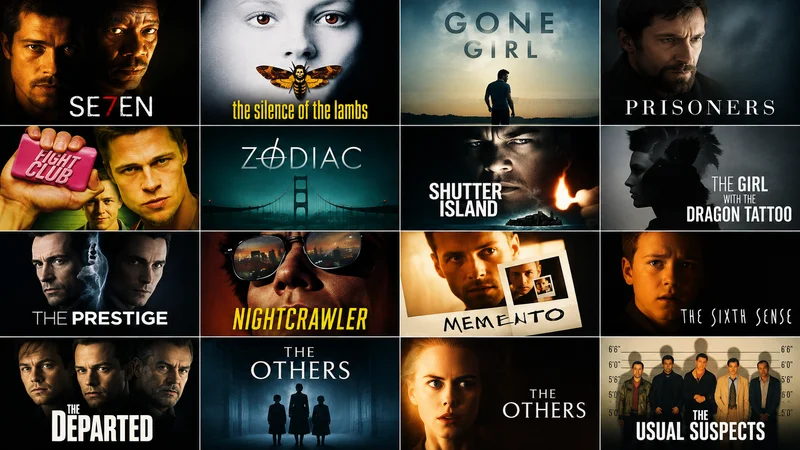
If you are hunting for the best mystery thriller movie to watch tonight, start with a story that makes every detail feel important. This list brings together 46 films, from elegant country-house puzzles and classic noir investigations to serial-killer cases, unreliable narrators, and recent mysteries such as Wake Up Dead Man and Weapons. The selections favor strong questions, intriguing evidence, and suspense that matters beyond a final surprise.
At CandyJar, we recommend mysteries for different moods rather than insisting that one twist fits everybody. Some titles offer clues viewers can solve alongside a detective; others make you question the person telling the story. You will find Hollywood classics, acclaimed international movies, dark psychological dramas, and lighter whodunits, each with quick facts and a spoiler-conscious assessment.
This best mystery thriller movie guide includes films released from 1954 through 2025. The list is arranged to help you discover styles of suspense, not to claim an objective ranking of artistic quality. Every movie appears with its original release year and a director credit, followed by its central mystery, reasons to watch, and any relevant warning about tone or difficult material.
How to Choose the Right Mystery Thriller
The best mystery thriller movie for you depends on what kind of uncertainty keeps you watching. Some films ask who committed a crime; others ask why a character is lying, whether a memory is trustworthy, or what happened to someone who vanished. Use these defining features to narrow the choices before browsing the individual recommendations.
- Unsolved crimes and missing people: A disappearance, murder, or suspicious event creates a question the story must investigate.
- Clues, red herrings, and competing alibis: Objects, testimony, and misleading details encourage viewers to test their own theories.
- Unreliable narrators and fractured memory: Conflicting accounts or unusual timelines make even the main character an uncertain source.
- Psychological tension and hidden motives: Secrets inside families, friendships, or professional relationships turn ordinary conversations into suspense.
- Contained settings and limited suspects: Trains, islands, mansions, and isolated communities create puzzle-like conditions.
- Consequential revelations: The strongest twists change the emotional or moral meaning of earlier events rather than existing only to shock.
If you prefer lighthearted deduction, begin with Knives Out or Clue. Choose Zodiac or Prisoners for darker investigations, Memento for a structural puzzle, and The Wailing or Weapons for mysteries that lean heavily into horror. Because several films depend on a major revelation, the descriptions below avoid identifying culprits or explaining endings.
Whodunits and Clever Murder Puzzles
Finding the best mystery thriller movie for a puzzle-loving evening often means choosing an interesting set of suspects and a story that plays fair with its clues. These films range from witty ensemble games to dark locked-room cases, with particular attention to motive, timing, and deception.
1. Knives Out (2019)
- Director: Rian Johnson
- Subgenre: Modern whodunit with family secrets
- Best for: A witty, accessible murder puzzle
When wealthy crime novelist Harlan Thrombey dies after a family gathering, detective Benoit Blanc enters a household full of relatives who have reasons to conceal the truth. Nurse Marta Cabrera becomes central to the case, and the plot continually rearranges what the audience thinks it knows. Rather than depending on one trick, the film makes the difference between telling the truth and presenting a convincing story its central game.
Daniel Craig’s eccentric detective provides humor without dissolving the stakes, while Ana de Armas gives the mystery an emotional point of view. The ensemble is funny, but the film is also sharp about class and inheritance. Begin here if you want a mystery that supplies clues, rewards attention, and never forgets that the suspects are people with competing interests.
2. Glass Onion: A Knives Out Mystery (2022)
- Director: Rian Johnson
- Subgenre: Island-set ensemble mystery
- Best for: Social satire and shifting alliances
Benoit Blanc joins a wealthy group of acquaintances on a private island where a planned murder-mystery game gives way to something far more serious. The characters are used to being insulated by fame, money, and proximity to power, making their competing explanations particularly slippery. The setting looks carefree, yet everyone is watching how much the others know.
Glass Onion is brighter and more openly satirical than its predecessor, with an emphasis on performance and public image. Its pleasure comes from the way an early impression can change once the same interaction is viewed differently. Watch it for a breezy mystery with elaborate setups, not for the dark atmosphere of a serial-killer procedural.
3. Wake Up Dead Man: A Knives Out Mystery (2025)
- Director: Rian Johnson
- Subgenre: Church-set locked-room mystery
- Best for: Faith, secrets, and detective reasoning
Benoit Blanc investigates the seemingly impossible death of a monsignor connected to a church community. A young priest and a circle of sharply different personalities complicate the case, while the appearance of a locked-room puzzle makes the physical circumstances almost as important as motive. The story asks what people choose to believe when an explanation seems impossible.
The third Blanc film adopts a more solemn atmosphere than Glass Onion while keeping the franchise’s affection for cleverly staged revelations. Josh O’Connor adds a vulnerable perspective alongside Daniel Craig’s detective. It works particularly well for viewers who like traditional puzzle structure with a moral dimension, though seeing the previous films is helpful rather than strictly required.
4. Murder on the Orient Express (1974)
- Director: Sidney Lumet
- Subgenre: Classic train-bound detective mystery
- Best for: A closed suspect list and elegant clue work
A murder aboard a luxury train leaves Hercule Poirot investigating passengers who cannot simply walk away from the crime scene. Stopped by snow, the train becomes an unusually tidy setting for interrogations, physical evidence, and conflicting testimony. Every person has a story, and the detective must decide which details belong together rather than accepting the most convenient explanation.
Lumet’s star-filled adaptation of Agatha Christie emphasizes conversation and performance over action. Its pleasure lies in watching a seemingly complete set of facts acquire a different meaning through careful questioning. Choose the 1974 version when you want a classic mystery atmosphere and a famous detective who treats the solution as more than a logical exercise.
5. Death on the Nile (1978)
- Director: John Guillermin
- Subgenre: Riverboat murder mystery
- Best for: Jealousy, inheritance, and glamorous suspects
Hercule Poirot finds himself on a Nile cruise where romantic rivalries and wealth produce a tense social environment before a murder takes place. The boat supplies a contained group of possible suspects, but their relationships are more entangled than they first appear. Poirot’s challenge is to connect opportunity with motive while resisting the distractions of dramatic behavior.
The 1978 adaptation brings an old-fashioned grandeur to the Christie formula, with striking scenery and an ensemble full of recognizable faces. It is ideal for viewers who enjoy interrogations and competing alibis in an elaborate setting. The rhythm is unhurried compared with modern thrillers, giving clues and character rivalries room to develop.
6. The Last of Sheila (1973)
- Director: Herbert Ross
- Subgenre: Yacht-set mystery game
- Best for: Elaborate clues and unpleasant suspects
A wealthy film producer invites a circle of Hollywood acquaintances onto a yacht and organizes a game built around private secrets. The playful atmosphere turns threatening when the puzzles begin to intersect with a real death. Each guest seems to know something about the others, making the competition as much about embarrassment and power as solving riddles.
Written by Anthony Perkins and Stephen Sondheim, the film is especially rewarding for viewers who enjoy trying to solve a puzzle before the characters do. Its social circle is deliberately sharp-edged, and not everyone is easy to like. The careful construction of its games makes it an excellent companion to modern ensemble mysteries such as Knives Out.
7. Clue (1985)
- Director: Jonathan Lynn
- Subgenre: Comic mansion whodunit
- Best for: Fast dialogue and playful mystery mechanics
Six strangers arrive at an isolated mansion using aliases, where an evening arranged around blackmail turns into chaos after a death. The guests search rooms, compare stories, and accuse one another while more disturbances threaten to expose everyone. The premise borrows the logic of the familiar board game and transforms it into a frantic series of misunderstandings.
Clue is primarily a comedy, but its locked-house structure makes it a lively entry in the mystery tradition. The rapid-fire performances and playful treatment of possible solutions are the main attraction. Choose it when you want a lighter film that still appreciates the pleasures of suspicious characters, hidden passages, and a dramatic reveal.
8. Gosford Park (2001)
- Director: Robert Altman
- Subgenre: Country-house murder mystery
- Best for: Class tensions and ensemble storytelling
A weekend gathering at an English country estate brings wealthy guests and household servants into the same crowded environment. When a death disrupts the visit, suspicion spreads through a system in which different people hear and see different things. The servants understand parts of the household that the guests barely notice, changing how the mystery can be approached.
Altman makes the social structure as important as the culprit, creating a film that rewards observation of background conversations and small gestures. It moves more slowly than a conventional crime thriller but offers greater depth about dependency and resentment. Viewers who enjoy character-rich ensemble dramas will find the investigation particularly satisfying.
9. The Girl with the Dragon Tattoo (2011)
- Director: David Fincher
- Subgenre: Cold-case investigation
- Best for: Dark family history and investigative partnership
Journalist Mikael Blomkvist is hired to investigate the decades-old disappearance of Harriet Vanger, a member of a wealthy Swedish family. His research gradually intersects with the work of brilliant hacker Lisbeth Salander. Family photographs, archives, and old records become urgent evidence in a case whose witnesses have had years to control what they reveal.
Fincher’s English-language adaptation has a chilly atmosphere and disturbing subject matter, including sexual violence. The partnership between Blomkvist and Salander is more interesting than a lone-genius detective formula because they notice different kinds of evidence. Choose it for a harsh, methodical mystery rather than a comfortable drawing-room puzzle.
10. The Invisible Guest (2016)
- Director: Oriol Paulo
- Subgenre: Spanish locked-room crime mystery
- Best for: Competing accounts and rapid reversals
Businessman Adrián Doria wakes in a locked hotel room beside the body of his lover and has little time to prepare a convincing defense. An accomplished legal adviser pushes him to reconstruct what happened, but every version of events seems to leave something unexplained. Most of the suspense comes from the conversation between two people testing the reliability of a story.
The film is built for viewers who enjoy noticing contradictions and reconsidering earlier scenes. Its momentum is strong despite the limited central setting, and revealing the ending beforehand would remove a major part of its appeal. Seek out the Spanish original, also known as Contratiempo, rather than confusing it with a later remake.
Serial-Killer Cases, Cold Cases, and Police Investigations
If your idea of the best mystery thriller movie involves detectives racing to understand disturbing evidence, start here. These investigations often carry harsher content and fewer comforting answers than a traditional mansion mystery. Some are inspired by real events; their dramatized details should not be mistaken for definitive findings.
11. Se7en (1995)
- Director: David Fincher
- Subgenre: Serial-killer investigation
- Best for: Bleak atmosphere and disturbing clues
Two detectives, one approaching retirement and one newly assigned to the city, investigate murders staged around the seven deadly sins. Each crime scene appears designed to communicate something, but understanding the message does not necessarily put them in control of the case. The unnamed urban setting becomes a place where decay and moral judgment seem inseparable.
Fincher’s visual restraint and oppressive soundscape make the investigation feel almost physically exhausting. The contrast between detectives Somerset and Mills gives the story an emotional argument about experience and anger. This is a grim choice with graphic material, but an essential example of suspense built around clues that may be deliberately misleading.
12. Zodiac (2007)
- Director: David Fincher
- Subgenre: True-crime procedural
- Best for: Long investigations and unresolved uncertainty
Reporters and detectives follow letters, ciphers, sightings, and possible suspects connected to the Zodiac killings in Northern California. As months become years, their lives change even when the evidence refuses to produce a definitive answer. The movie is as interested in obsession with a case as it is in the original crimes.
Its unusual power lies in making procedural frustration absorbing. Fincher uses documents, geography, and time to show how a mystery can consume people without promising closure. This dramatization draws from a real unresolved case, but its interpretations should not be mistaken for a judicial determination of guilt. Patient viewers are rewarded more than those demanding a neat ending.
13. The Silence of the Lambs (1991)
- Director: Jonathan Demme
- Subgenre: Psychological crime investigation
- Best for: Mind games and forensic tension
FBI trainee Clarice Starling seeks information from imprisoned psychiatrist Hannibal Lecter while authorities search for a serial killer. Their conversations combine useful details with attempts to gain psychological advantage. Clarice must decide which questions will help the investigation without allowing Lecter to direct the entire exchange.
Jodie Foster gives Clarice determination and vulnerability, making her intelligence evident through careful listening rather than grand speeches. Anthony Hopkins creates menace even when his character is physically confined. The film contains disturbing violence, but its greatest tension often comes from eye contact, silence, and the difficulty of establishing trust.
14. Prisoners (2013)
- Director: Denis Villeneuve
- Subgenre: Child-disappearance mystery
- Best for: Moral pressure and layered clues
When two young girls disappear, their families and a determined detective pursue answers under mounting pressure. One father becomes convinced that ordinary investigative limits are inadequate and takes matters into his own hands. The story intertwines a procedural search with an escalating argument about what fear can make someone justify.
Hugh Jackman and Jake Gyllenhaal embody sharply different approaches to a desperate case. Villeneuve’s rain-soaked imagery and careful pacing create an unusually heavy atmosphere, while the puzzle remains central. The material includes abuse and child endangerment, making it intense viewing. Its moral complexity lingers longer than a simple culprit reveal.
15. Memories of Murder (2003)
- Director: Bong Joon-ho
- Subgenre: South Korean serial-murder investigation
- Best for: Procedural failures and social context
Detectives in rural South Korea struggle to identify a killer as their methods clash, evidence proves unreliable, and public pressure increases. The film moves between uncomfortable comedy and dread without treating the underlying violence casually. It is as much a study of investigative assumptions as an account of individual suspects.
Bong Joon-ho makes the limitations of the investigators part of the suspense, refusing to equate certainty with competence. The story draws on historical murders, while its incidents and characters are dramatized. Anyone who values human complexity and unsettling ambiguity over a tidy puzzle solution should consider this a priority.
16. The Secret in Their Eyes (2009)
- Director: Juan José Campanella
- Subgenre: Argentine cold-case mystery
- Best for: Memory, justice, and unspoken love
A retired legal investigator in Argentina revisits a murder case that has haunted him for decades. His search moves between present recollection and the events of a politically turbulent earlier era. The people involved continue living with the case, making the meaning of justice more complicated than identifying one guilty person.
Campanella blends an emotionally involving relationship drama with an absorbing investigation. The film rewards patience because memories, personal loyalties, and procedural details eventually intersect. Choose the 2009 Argentine original rather than the differently plotted 2015 American remake if you want the film discussed here. Its emotional consequences matter as much as the answer.
17. The Chaser (2008)
- Director: Na Hong-jin
- Subgenre: South Korean pursuit thriller
- Best for: An urgent search with dangerous uncertainty
A former detective working as a pimp notices that women connected to his operation have disappeared and begins tracking a suspicious customer. His pursuit quickly becomes entangled with a police response that is not as efficient as the situation demands. The audience feels the urgency of information arriving too late or being mishandled.
The Chaser is more abrasive and violent than a conventional whodunit, but the mystery of where the missing women are and what can be proven drives its momentum. Na Hong-jin creates dread by turning small delays into serious obstacles. It is best for viewers comfortable with dark crime material and relentless pacing.
18. Cure (1997)
- Director: Kiyoshi Kurosawa
- Subgenre: Japanese psychological crime mystery
- Best for: Hypnotic dread and unsettling questions
A detective investigates a series of murders committed by different people who seem unable to explain why they acted. As he follows the pattern, a mysterious drifter becomes central to the inquiry. The case begins to undermine the detective’s confidence that motive can always be understood through familiar police methods.
Cure is quiet, eerie, and deliberately resistant to reassuring explanations. Its terror grows from ordinary rooms and seemingly mundane conversation rather than jump scares. Choose it if you like mystery stories that are willing to leave some uncertainty in place; viewers who prefer every mechanism spelled out may find it challenging.
19. The Bone Collector (1999)
- Director: Phillip Noyce
- Subgenre: Forensic serial-killer thriller
- Best for: Physical clues and collaborative deduction
A quadriplegic forensic investigator works with a young police officer to interpret evidence left at disturbing murder scenes. Their collaboration becomes essential because the investigator cannot personally visit the locations. The story develops around the distinction between observing a detail and knowing what it means.
Denzel Washington and Angelina Jolie provide a compelling central partnership, while the elaborate crime-scene clues add a classic puzzle element. It is more sensational than a realistic procedural, so its methods are best viewed as genre entertainment. Pick it for brisk clue gathering and escalating danger, not documentary-level forensic accuracy.
20. The Vanishing (1988)
- Director: George Sluizer
- Subgenre: Dutch-French disappearance mystery
- Best for: Psychological obsession and dread
After his partner disappears during a stop at a roadside service station, a man becomes consumed by the need to know what happened. Years later, an unsettling opportunity seems to offer the answer he has been pursuing. The film’s mystery rests not only on an event but on the price of knowing with certainty.
The Vanishing, originally released as Spoorloos, builds suspense with ordinary places and behavior rather than conventional action. Its carefully controlled storytelling is far more disturbing than the modest premise first suggests. Watch the 1988 original, not the 1993 English-language remake, if you want the uncompromising version that made it influential.
Psychological Mysteries and Unreliable Truths
The best mystery thriller movie built around a damaged memory or deceptive perspective can keep you reconsidering what you have already seen. This group emphasizes identity, guilt, perception, and personal secrets. Many are best watched with as little advance plot knowledge as possible.
21. Memento (2000)
- Director: Christopher Nolan
- Subgenre: Nonlinear memory mystery
- Best for: Reconstructing facts from fragments
Leonard Shelby uses photographs, notes, and tattoos to track the person he believes murdered his wife, because he cannot form lasting new memories. The film’s unusual structure forces viewers to assemble events without the reassurance of a reliable chronology. Every apparently useful piece of information raises the question of who recorded it and why.
The formal experiment has an emotional purpose: Leonard’s desperate need for certainty makes him vulnerable to manipulation. Guy Pearce gives the character determination and fragility, balancing the movie’s intellectual puzzles with real feeling. It is an excellent pick if you enjoy working out the story’s structure while questioning whether the protagonist’s goal has distorted his judgment.
22. Shutter Island (2010)
- Director: Martin Scorsese
- Subgenre: Island-set psychological investigation
- Best for: Paranoia and uncertain perception
Two federal marshals arrive at a remote psychiatric facility to investigate the disappearance of a patient. A storm, evasive staff, and troubling details about the institution deepen the lead investigator’s suspicions. As the inquiry expands, personal memories begin competing with the explanation he expects to find.
Scorsese draws on gothic horror and detective cinema to create a world where every corridor seems meaningful. Leonardo DiCaprio gives the central character an emotional intensity that makes his uncertainty contagious. This is best watched without ending explanations; its clues are most effective when you can reconsider them after the final scenes.
23. The Conversation (1974)
- Director: Francis Ford Coppola
- Subgenre: Surveillance-driven psychological mystery
- Best for: Listening for meaning and doubting evidence
Surveillance specialist Harry Caul records a conversation between two strangers and starts worrying that his work may contribute to a murder. He repeatedly analyzes the recording, searching for a meaning that remains just out of reach. The case develops through sound, memory, and the uncomfortable realization that collecting evidence is not the same as understanding it.
Gene Hackman’s guarded performance turns Harry’s expertise into an emotional trap: the more he listens, the less secure he feels. The film also intersects with state-secrecy and surveillance stories, making it a natural companion to our guide to best political thriller movies. It is ideal for viewers who appreciate quiet dread and ethical tension over action.
24. Gone Girl (2014)
- Director: David Fincher
- Subgenre: Marriage and disappearance mystery
- Best for: Media narratives and manipulative relationships
When Amy Dunne disappears on her fifth wedding anniversary, her husband Nick becomes the subject of a public and police investigation. Media appearances, diary entries, and competing accounts of the marriage start shaping the story before the facts are clear. The central mystery is inseparable from how each spouse presents themselves to others.
Fincher gives the film the polish of a domestic drama while making image management a source of suspense. Rosamund Pike and Ben Affleck embody a relationship in which perception is dangerously powerful. Choose it for sharp narrative reversals and social observation, while expecting a cynical tone and disturbing behavior rather than a reassuring romance.
25. The Sixth Sense (1999)
- Director: M. Night Shyamalan
- Subgenre: Supernatural psychological mystery
- Best for: Atmosphere and emotional clues
A child psychologist tries to help a boy who claims he can see dead people. Their meetings gradually reveal how fear shapes the boy’s life and how adults struggle to understand what he is experiencing. The central question is not simply whether the supernatural exists, but what the encounters mean to the people involved.
Shyamalan uses careful framing and a subdued pace to make everyday locations uneasy. Haley Joel Osment and Bruce Willis give the mystery a warmth that distinguishes it from harsher horror thrillers. Its famous revelation makes spoiler avoidance essential, but the emotional groundwork is what allows the ending to matter beyond surprise.
26. The Others (2001)
- Director: Alejandro Amenábar
- Subgenre: Haunted-house mystery
- Best for: Isolation and shifting explanations
Grace lives with her two light-sensitive children in a vast, secluded house after World War II. Strange noises and the arrival of new servants undermine the strict rules she has established to keep the household safe. The film builds mystery through what the family believes is happening within familiar walls.
Nicole Kidman’s controlled performance makes the house feel governed by both love and fear. Amenábar favors shadows, silence, and carefully withheld information over constant shocks. This is an especially rewarding choice if you enjoy ghost stories structured like detective puzzles, where learning one fact changes how you interpret several earlier scenes.
27. The Machinist (2004)
- Director: Brad Anderson
- Subgenre: Unreliable-narrator psychological thriller
- Best for: Guilt, insomnia, and distorted perception
Industrial worker Trevor Reznik has been unable to sleep for an extraordinarily long time and becomes convinced that people around him are hiding something. Workplace accidents, unfamiliar notes, and a mysterious colleague feed his suspicion. The viewer must decide how much of the story is external danger and how much is filtered through Trevor’s deteriorating state.
Christian Bale’s physical transformation is striking, but the movie’s lasting value is its construction of a mind seeking explanations. The grim industrial setting reinforces the sense of isolation. Choose it for unsettling psychological clues and an atmosphere of exhaustion rather than fast-paced action or traditional detective work.
28. The Game (1997)
- Director: David Fincher
- Subgenre: Reality-bending conspiracy mystery
- Best for: Uncertainty about who controls events
Wealthy banker Nicholas Van Orton receives a mysterious birthday gift that invites him into an elaborate game organized by a secretive company. Soon, ordinary routines become threatening, and he cannot tell whether the disturbances around him are designed entertainment or genuine danger. Every attempt to establish control seems to lead to another unanswered question.
Michael Douglas makes Nicholas difficult but fascinating as a man forced outside his familiar systems. Fincher uses the film’s escalating uncertainty to keep the audience questioning the same events. It is a more kinetic puzzle than Memento, particularly appealing if you enjoy being unsure which scenes can be trusted.
29. Mulholland Drive (2001)
- Director: David Lynch
- Subgenre: Surreal Hollywood mystery
- Best for: Dream logic and ambiguous identities
An aspiring actress in Los Angeles meets a woman suffering from amnesia after a car accident. They search for clues about the woman’s identity, while seemingly unrelated events begin drawing the story into stranger territory. The film offers recognizable detective ingredients but rearranges them into a dreamlike experience.
Lynch deliberately refuses a single straightforward path to certainty. Performances, identities, and emotions matter as much as a solution to the literal questions. Choose it when you are comfortable interpreting clues rather than receiving definitive answers. Its atmosphere can be hypnotic, but viewers wanting a conventional solved case may find it frustrating.
30. The Prestige (2006)
- Director: Christopher Nolan
- Subgenre: Rival-magician mystery
- Best for: Obsession and hidden methods
Two stage magicians in Victorian London develop an increasingly destructive rivalry as each tries to understand the other’s most astonishing illusion. Journals, performances, and technical secrets become pieces of a puzzle about ambition and deception. The story constantly asks what someone is willing to sacrifice to create a convincing spectacle.
Nolan’s layered structure makes the audience participate in the same process of misdirection as the characters. Hugh Jackman and Christian Bale give the rivalry genuine emotional damage beneath its puzzle mechanics. It is particularly satisfying for viewers who appreciate carefully planted details and are willing to revisit scenes with a different understanding.
31. The Handmaiden (2016)
- Director: Park Chan-wook
- Subgenre: Period psychological con mystery
- Best for: Deception, desire, and changing perspectives
In Japanese-occupied Korea, a young woman enters a wealthy household as a maid while secretly participating in a plan to deceive the heiress she serves. The apparent arrangement changes as relationships develop and pieces of the story are reconsidered from another perspective. What looks like a straightforward con becomes much more personal and unpredictable.
Park Chan-wook combines meticulous production design with audacious narrative shifts, making the act of retelling central to the suspense. The film contains explicit sexual material and disturbing coercive dynamics, so it is not suitable for every audience. Those comfortable with the content will find a deeply layered mystery about control over stories and identities.
Noir Classics, International Twists, and New Mysteries

When choosing the best mystery thriller movie beyond the familiar modern whodunit, noir classics and international films offer different rhythms and moral stakes. The final selections also include recent mysteries whose unusual formats or settings give old detective questions a fresh shape.
32. Rear Window (1954)
- Director: Alfred Hitchcock
- Subgenre: Apartment-window murder suspicion
- Best for: Visual clues and voyeuristic suspense
A photographer recovering from a broken leg spends his days watching neighbors from his apartment and begins to suspect a murder has taken place across the courtyard. Because he cannot freely investigate, small movements, missing objects, and changes in routine take on unusual significance. His girlfriend and nurse help him test the possibility that he has witnessed a crime.
Hitchcock turns an ordinary view into a gripping puzzle about what observation can and cannot prove. James Stewart and Grace Kelly bring warmth and wit to a potentially claustrophobic setup. It is a welcoming classic for viewers who like spotting clues in plain sight, although the film also questions the privacy costs of watching other people.
33. Vertigo (1958)
- Director: Alfred Hitchcock
- Subgenre: Identity and obsession mystery
- Best for: Doubles, memory, and unreliable appearances
Former detective Scottie Ferguson follows a woman whose behavior seems linked to a mysterious past. His investigation becomes intertwined with his own fears and fixation, gradually shifting the meaning of what he thinks he knows. San Francisco locations, visual patterns, and repeated gestures make the uncertainty feel dreamlike.
The film is less a conventional whodunit than a disturbing study of obsession and constructed identity. Hitchcock’s elaborate imagery rewards viewers who enjoy mysteries that become psychologically uncomfortable. It asks serious questions about the ways desire can distort another person’s individuality, so the central relationship should not be mistaken for healthy romance.
34. Chinatown (1974)
- Director: Roman Polanski
- Subgenre: Los Angeles private-eye noir
- Best for: An investigation leading toward systemic corruption
Private detective Jake Gittes accepts what appears to be a routine marital investigation in 1930s Los Angeles. As evidence begins contradicting his client’s account, the assignment expands into a mystery involving land, water, wealth, and a powerful family. Gittes discovers that finding facts does not guarantee he can protect the people affected by them.
Robert Towne’s screenplay links an intimate crime story to the larger world of money and influence. Jack Nicholson supplies sharp investigative energy, while the sunny setting contrasts with the increasingly bleak discoveries. Choose it for an intricate noir mystery that treats power as part of the puzzle rather than merely background decoration.
35. L.A. Confidential (1997)
- Director: Curtis Hanson
- Subgenre: 1950s police corruption mystery
- Best for: Interlocking investigations and competing loyalties
Three Los Angeles police officers with sharply different methods become involved in a network of murders, political influence, and police misconduct. Each pursues pieces of the case with personal ambitions that complicate the search. As their investigations overlap, details that initially seem unrelated begin to expose a much broader pattern.
The period atmosphere is polished, but the film’s real strength is how it balances several investigators without giving any one a monopoly on truth. Guy Pearce, Russell Crowe, and Kevin Spacey create contrasting points of view. It is a satisfying option for viewers seeking a richly plotted detective story with moral conflict and a strong noir identity.
36. The Usual Suspects (1995)
- Director: Bryan Singer
- Subgenre: Crime interrogation mystery
- Best for: Uncertain testimony and criminal mythology
After a deadly incident involving a ship, a surviving small-time criminal recounts how a group of suspects came together and became connected to a feared underworld figure. The police attempt to piece together events from a story told by someone who may have his own reasons for emphasizing certain details. The investigation depends almost entirely on the reliability of the account.
The movie became famous for its treatment of narration and surprise, making advance spoilers particularly damaging. It is a strong pick for those who like reconstructing timelines and asking who controls a story. Some characterizations are stylized, but the film’s central narrative gamble remains its principal attraction.
37. Identity (2003)
- Director: James Mangold
- Subgenre: Storm-bound motel mystery
- Best for: Suspects trapped in one location
A collection of strangers becomes stranded at a remote motel during a severe storm, and a series of deaths suggests that someone among them is responsible. Flooded roads and fragmented personal histories make escape and trust difficult. As the group tries to establish connections, the story adds another puzzle concerning identity and perception.
Identity is designed for a night when you want quick escalation, eerie atmosphere, and a puzzle that changes shape. The cast commits to the heightened setup, while the isolated motel creates an effective pressure cooker. It is less interested in strict realism than in the tension of repeatedly reconsidering the premise.
38. The Body (2012)
- Director: Oriol Paulo
- Subgenre: Spanish morgue mystery
- Best for: Disappearance and intertwined timelines
A woman’s body vanishes from a morgue, setting off an investigation that draws attention to her husband’s account of the days preceding her death. Missing evidence and unstable timelines make even basic assumptions hard to trust. The case grows through interrogations and remembered incidents rather than a succession of unrelated action scenes.
Paulo’s earlier mystery showcases the structural reversals that later became associated with The Invisible Guest. It is ideal for viewers who enjoy testing one explanation against another and do not mind substantial narrative manipulation. Watch the Spanish-language 2012 original rather than unrelated productions with the same English title.
39. Tell No One (2006)
- Director: Guillaume Canet
- Subgenre: French missing-person conspiracy
- Best for: A long-buried personal secret
Eight years after his wife’s apparent murder, a doctor receives evidence suggesting she might still be alive. As he searches for answers, new suspicions place him in danger and complicate his relationship with investigators. The plot makes every new clue personally urgent, since the truth may overturn the central loss of his life.
Based on Harlan Coben’s novel, Tell No One combines the emotional pull of a missing loved one with the forward drive of a fugitive thriller. François Cluzet gives the lead’s confusion believable weight. It suits viewers who want frequent developments but still need a personal reason to care about each revelation.
40. The Wailing (2016)
- Director: Na Hong-jin
- Subgenre: Korean supernatural murder mystery
- Best for: Competing explanations and rural dread
A police officer investigating strange deaths and illnesses in a rural village becomes increasingly frightened for his own family. Rumors about an outsider, unfamiliar rituals, and conflicting advice complicate what he believes is happening. Each apparent explanation seems to answer one question while generating another more disturbing one.
The Wailing combines procedural inquiry with folk horror, allowing uncertainty to remain frightening long after a conventional detective story would narrow its suspects. Its violence and supernatural content make it intense viewing. Choose it if you like an atmosphere that grows stranger as evidence accumulates rather than a single straightforward criminal solution.
41. Searching (2018)
- Director: Aneesh Chaganty
- Subgenre: Screenlife missing-person investigation
- Best for: Digital evidence and family secrets
After his teenage daughter disappears, David Kim searches her online accounts and digital activity for information that could help investigators. Messages, videos, location details, and overlooked habits become the tools of an increasingly personal inquiry. The computer-screen format makes viewers read and interpret evidence along with the father.
John Cho gives the story emotional urgency, keeping the technology from becoming a novelty. The script knows how to plant clues in seemingly routine online interactions and encourages attentive viewing. It is a particularly accessible modern mystery for audiences who like puzzles rooted in everyday digital life.
42. Missing (2023)
- Director: Will Merrick and Nick Johnson
- Subgenre: Screenlife disappearance thriller
- Best for: Internet sleuthing across borders
When her mother fails to return from a trip abroad, teenager June uses digital tools to trace the last known movements of the adults involved. As she gathers fragments from screens, messages, and online services, her initial picture of the situation begins to change. The format keeps the search moving while repeatedly challenging what she assumes about her family.
Missing is a standalone story connected in format and creative lineage to Searching, so it can be enjoyed independently. Storm Reid makes June resourceful without presenting technology as an automatic source of truth. Choose it for brisk modern puzzle-solving and escalating discoveries, while remembering that some of its digital shortcuts are dramatized for entertainment.
43. The Night of the 12th (2022)
- Director: Dominik Moll
- Subgenre: French unsolved-murder procedural
- Best for: An investigation without easy closure
Police captain Yohan Vivès investigates the murder of a young woman named Clara and finds himself confronting a long series of interviews, competing theories, and institutional frustrations. The case draws the team into the victim’s relationships, but a complete account proves difficult to construct. Investigators must live with the gap between suspicion and proof.
The film’s emotional force comes from refusing to make the victim a mere instrument for clever plot mechanics. Inspired by material in a true-crime book, the story is a dramatization rather than a precise reconstruction of one case. It is a strong option for viewers who appreciate the human costs of uncertainty more than a decisive final reveal.
44. Conclave (2024)
- Director: Edward Berger
- Subgenre: Vatican succession mystery
- Best for: Secrets and shifting alliances in isolation
Cardinals gather behind closed doors to elect a new pope after the death of the previous pontiff. Cardinal Lawrence must manage the process as private histories and potentially consequential information begin emerging. The ritualized environment gives the story clear rules, while the characters’ hidden concerns create a suspenseful puzzle about whom to trust.
Conclave is a political and institutional mystery with the tension of a locked-room drama, rather than a conventional murder investigation. Ralph Fiennes leads a restrained ensemble, and the visual design emphasizes secrecy within ceremonial spaces. It is ideal for viewers who like dialogue, observation, and the gradual effect of new information on a closed group.
45. Black Bag (2025)
- Director: Steven Soderbergh
- Subgenre: Espionage mole mystery
- Best for: Marriage and suspicion among intelligence agents
British intelligence officer George Woodhouse is assigned to investigate a possible traitor among a small set of colleagues, including his wife Kathryn. He must determine which relationships are trustworthy while knowing that everyone is trained to conceal information. The investigation turns social encounters and domestic intimacy into opportunities for strategic misdirection.
Michael Fassbender and Cate Blanchett give the film a stylish emotional tension beneath its spy-story mechanics. Soderbergh keeps the pace tight and relies on deduction and dialogue rather than spectacle. It is a useful contemporary choice for viewers who like secrets within a limited circle, even if espionage is not their usual mystery subgenre.
46. Weapons (2025)
- Director: Zach Cregger
- Subgenre: Horror mystery with multiple perspectives
- Best for: A town searching for missing children
When nearly every child from one elementary-school class disappears during the same night, their community struggles to understand how such an event could have occurred. Suspicion spreads among parents, teachers, and neighbors, while separate perspectives reveal different pieces of the story. The central question is as unsettling as it is simple: where did the children go?
Weapons blends mystery structure with disturbing horror imagery, so it is best suited to viewers comfortable with frightening and sometimes graphic material. Cregger’s shifting perspectives allow the mystery to develop through partial information instead of one detective’s viewpoint. For a recent film in which dread and curiosity reinforce each other, it is a memorable choice.
Frequently Asked Questions
What is the best mystery thriller movie to watch first?
Knives Out is a friendly starting point because its suspects and clues are clear while its humor keeps the tone approachable. If you would rather begin with a classic, Rear Window offers a tightly framed mystery that rewards careful observation. Your ideal first choice depends on whether you prefer playful deduction or suspenseful suspicion.
Which mystery thrillers have the most surprising twists?
Memento, The Invisible Guest, Shutter Island, The Usual Suspects, and The Prestige are particularly associated with revelations that change how earlier information is interpreted. Watch without trailers that reveal late scenes, and avoid searching for ending explanations before finishing the film.
Which films are best for fans of detective investigations?
Try Zodiac for a patient true-crime-inspired investigation, Memories of Murder for procedural uncertainty, The Secret in Their Eyes for a lingering cold case, and The Night of the 12th for a realistic study of difficult police work. They vary in pace and willingness to provide closure.
Are there good mystery thrillers without graphic violence?
Knives Out, Glass Onion, Clue, and Gosford Park offer puzzles with relatively lighter tones than Se7en or The Chaser, although they still deal with murder or threatening situations. Always check the current age rating and content guidance if you have specific sensitivities.
Where can I stream these mystery thriller movies?
Streaming and rental rights vary by country and change frequently. Search the exact film title and release year on licensed services, then confirm audio, subtitles, and rental conditions. The Spanish The Body and The Invisible Guest, for example, should not be confused with films or remakes using similar English titles.
Final Thoughts
There is no single best mystery thriller movie for every viewer. Knives Out is inviting and playful, Zodiac makes investigative uncertainty absorbing, The Conversation explores how evidence can be misheard, and Weapons mixes a missing-person puzzle with frightening horror. The best next choice is the one that matches your tolerance for darkness, your patience for clues, and whether you want every question answered. Whatever you pick, the most rewarding mysteries make you care about the truth before revealing it.

Julian Parker is a dedicated entertainment writer at CandyJar, specializing in short dramas, captivating storylines, and trending mini-series. He shares insightful reviews, fresh perspectives, and thoughtful recommendations to help viewers discover stories worth watching.